Key Takeaways
- The ScaleOps AI SRE Agent connects directly to live Kubernetes clusters to investigate workloads, rank optimization opportunities by cost impact, and execute approved changes without switching between monitoring tools, runbooks, and dashboards.
- Continuous workload awareness powered by predictive models that understand behavioral baselines, distinguish anomalies from expected variance, and define what right-sizing looks like for each workload.
- The agent operates in read-only mode by default and requires explicit human approval before modifying cluster state, and can be deployed self-hosted in air-gapped environments with no data egress.
SREs, DevOps, and platform engineers spend hours jumping between monitoring dashboards, runbooks, and Slack threads just to figure out what’s going wrong, and what to do about it. The signal is buried in noise, the context is scattered, and the toil never stops.
An LLM with cluster access can tell you CPU utilization is high. It can’t tell you whether that’s a genuine resource constraint or expected behavior for a batch job mid-run. It has no workload history, no scaling context, no sense of what rightsized looks like for a Java service versus a Spark executor. It reads metrics. It doesn’t understand them.
The ScaleOps AI SRE Agent is different because it’s built on top of the same engine that has been continuously analyzing and optimizing production Kubernetes workloads. Ask it where your biggest resource waste is, and it already knows your workloads, their history, and what good looks like. It surfaces the answer ranked by cost impact, with the context to back it up and the action to fix it.
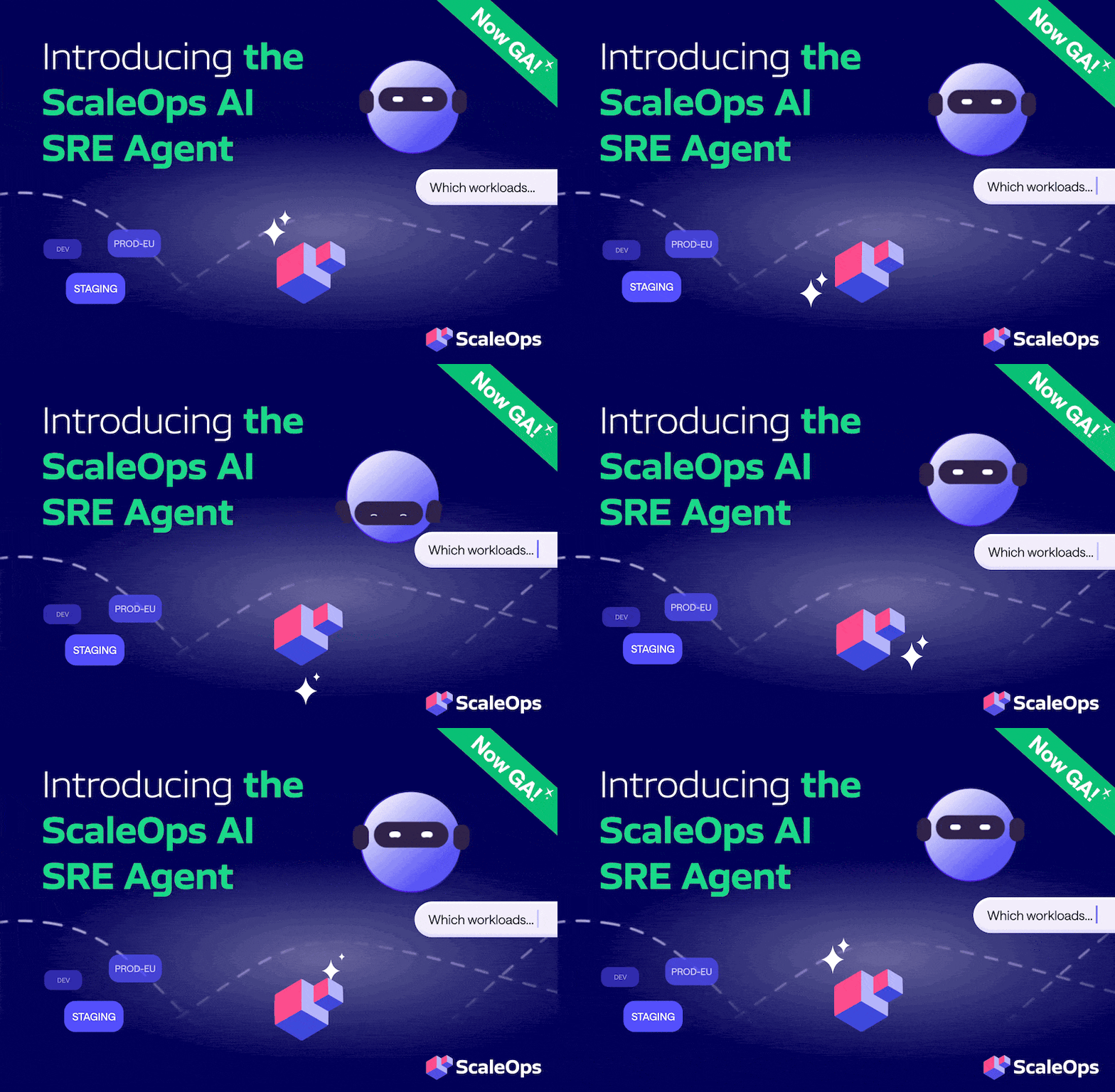
Today we’re launching the ScaleOps AI SRE Agent, a context-aware agent wired directly into your live cluster data. Ask it about any workload, any issue, any optimization opportunity, and it investigates in real time, ranks what matters most, and lets you execute approved changes on the spot.
Contextually Aware
The AI SRE Agent is powered by ScaleOps’ intelligence layer: continuous, pod-level analysis of your workloads across metrics, configurations, scaling behavior, and resource usage over time. It’s not querying snapshots. It maintains a live, evolving model of each workload in your cluster.
That means when you ask a question, the agent already has context. It knows each workload’s behavioral baseline, so it can distinguish an anomaly from expected variance. It understands namespace-level patterns and shared resource constraints, so findings aren’t scoped to a single pod in isolation.
How the ScaleOps AI SRE Agent Works
The ScaleOps AI SRE agent connects directly to your clusters via MCP and works against real-time data. When you explore optimization opportunities or simply ask it a question, here’s what happens:
- Collect: The agent continuously ingests live cluster data, including metrics, configurations, and workload behavior. The agent works on top of this always up-to-date dataset, not periodic scans or static snapshots.
- Analyze: The agent evaluates each workload in context, combining resource usage, scaling patterns, and reliability signals. It identifies inefficiencies and risks based on real usage over time, not isolated metrics.
- Prioritize: Findings are ranked by impact across cost, performance, and reliability. The agent surfaces what actually matters, tied to specific workloads, so engineers can focus immediately on high-value opportunities.
- Explain: Each insight is presented with clear context: what is happening, why it matters, and what the expected outcome is. No noisy alerts or vague suggestions, just concrete, workload-level conclusions.
- Act and Automate: Actions can be triggered directly from the agent, whether it is automation of any of ScaleOps features, node optimizations, or health issues investigation. Once applied, ScaleOps automation continuously maintains and adapts these improvements over time.
In practice: JVM memory issues, diagnosed and automated
A Java service starts throwing latency spikes. The on-call engineer asks the agent: “What’s going on with orders-service?”
The agent pulls the full JVM breakdown: heap vs. non-heap usage, GC frequency and pause times, memory pressure, OOM signals. It analyzes the data and understands what’s happening. The JVM heap ceiling is too low relative to actual heap usage. GC is running constantly to compensate, blocking threads on every cycle. The container memory request was set without accounting for non-heap overhead, so the JVM has even less headroom than the numbers suggest. This has been the configuration since the service was deployed.
The engineer enables Java automation. ScaleOps takes over: aligns heap sizing with observed usage, accounts for non-heap allocations in the container limit, and continuously tracks both as traffic patterns shift. No config files to touch, no restarts required.
GC pause times drop. Latency normalizes. The container is running leaner than before, because the limits now reflect what the workload actually needs.
Key Capabilities
Actionable, Not Just Informational
Responses are structured with visual prioritization (critical issues highlighted, warnings flagged, healthy items dimmed), specific workload identification by name and namespace, and priority-ranked findings with the most urgent items first. Every response ends with a clear next step, and engineers can trigger automations directly from the agent without switching tools.
Unified Investigation and Execution
The AI SRE Agent combines live cluster analysis with RAG-powered answers from the ScaleOps knowledge base in a single interface. When the agent flags an overprovisioned workload, the recommendation comes packaged with the supporting data, the expected impact, the relevant documentation, and the action to take. Engineers don’t need to context-switch between monitoring tools, docs, and runbooks. Investigation and execution happen in one place.
Safe, Read-Only, and Built for Production
The agent is agentic, but not reckless. It operates in read-only mode by default and does not modify cluster state without explicit approval. The investigation runs autonomously; the execution requires a human in the loop. All interactions are observable and audit-friendly. Cluster data remains isolated and is never used for model training.
Get Started
The ScaleOps AI SRE Agent is built for platform engineering, DevOps and SRE teams managing Kubernetes infrastructure, whether you’re running a handful of clusters or operating at scale across multiple environments. If your team is burning hours on manual investigation, resource optimization, or reliability triage, this agent takes that work off their plate.
The AI SRE Agent is now generally available. To get started, request a demo or start a free 14 day trial.
Frequently Asked Questions
What makes the ScaleOps AI SRE Agent different from ChatGPT for Kubernetes?
The agent connects directly to live clusters via MCP and uses continuous Workload Awareness models to understand behavioral baselines and predict right-sizing, while basic LLMs only read static metrics without understanding what’s normal for each workload.
Does the AI agent automatically change my Kubernetes cluster settings?
No, the agent operates in read-only mode by default and requires explicit human approval before executing any modifications to cluster state.
How does the agent prioritize which Kubernetes workloads to optimize first?
The agent ranks optimization opportunities by cost impact and provides specific workload identification with expected savings for each recommendation.
What kind of questions can I ask the ScaleOps AI SRE Agent?
Platform engineers can ask natural language questions like “where are we wasting the most money” and receive prioritized findings with actionable recommendations.