At scale, every platform or DevOps team runs into the same challenge: Kubernetes infrastructure drifts faster than humans can correct it. Pods are overprovisioned, nodes run unoptimized, horizontal and vertical autoscalers fight each other, and latency spikes during load, even in the most disciplined environments.
It doesn’t matter whether you’re all-in on a single provider or spread across AWS, GCP, and Azure. The core challenge is the same:
How do you keep workloads reliable, efficient, and cost-effective without engineers hand-tuning the system every week?
This is where autonomous resource management comes in. In this post, we’ll break down how resource automation actually works in production, why single-cloud and multi-cloud environments introduce different kinds of operational friction, and how ScaleOps provides a single optimization layer that keeps everything predictable, performance, and cost-effective across any cloud footprint.
What is Multi-Cloud Kubernetes Optimization?
Multi-cloud Kubernetes optimization is the practice of managing pod resources, node capacity, and autoscaling behavior consistently across Kubernetes clusters running on more than one cloud provider. The goal is to maintain the same level of cost efficiency, performance, and reliability across EKS, GKE, AKS, on-prem, or hybrid clusters, without operating three separate optimization stacks.
In practice, multi-cloud Kubernetes optimization covers four operational areas:
- Pod-level rightsizing: managing CPU and memory requests against observed usage, continuously, in every cluster regardless of provider
- Node-level efficiency: ensuring bin-packing, consolidation, and Spot or preemptible capacity are applied with the same logic across clouds
- Replica management: scaling replica counts based on actual demand patterns rather than static configuration per cluster
- Governance and safety: applying the same PodDisruptionBudgets, security policies, and SLO guardrails across every cloud
The challenge is not the absence of cloud-specific tools. AWS, Google Cloud, and Azure each ship competent native scaling and cost tooling. The challenge is that each cloud’s tools optimize against different inputs, with different defaults, in different consoles, which produces inconsistent outcomes across a multi-cloud footprint.
Solving multi-cloud Kubernetes optimization requires a single optimization layer that produces accurate inputs (pod requests, replica counts, scheduling decisions) for whichever cloud’s native autoscaler is running underneath.
How Resource Automation Works in Real Life
Resource automation functions as the intersection of workloads and infrastructure, allowing you to establish application capacity requirements, deployment locations, and resource security boundaries. It then maintains these through continuous comparison between actual conditions and your defined intentions.
An autonomous resource management system manages:
- Pod and replica rightsizing
- Placement and binpacking
- Node consolidation
- Governance
- Context-based scaling
Implementing an autonomous resource management system begins with adopting a control‑plane‑first approach, combining declarative APIs with GitOps workflows and standardized policy sets. This helps organizations minimize one-off, hand-configured clusters while preventing provider-specific drift.
The control plane has a few functions:
- Handles workload scaling and resource optimization
- Maintains default security standards through PodDisruptionBudgets (PDBs), Pod Security Admission (PSA), and OPA/Kyverno and image allowlists
- Enforces SBOM coverage and least-privileged identities for all workloads
The automation layer incorporates governance and safety into the core of the system, treating the two concepts as requirements rather than optional add-ons.
Achieving this autonomous control plane is the key to mastering either single-cloud or multi-cloud. ScaleOps provides a continuous automation and optimization platform, delivering these unique capabilities, whether you choose a single-cloud or multi-cloud strategy.
When Single‑Cloud Wins
Many high-performing teams choose to operate primarily in one cloud because it reduces cognitive load: one IAM model, one billing system, one set of managed services, one operational playbook.
But even in single-cloud setups, Kubernetes scaling complexity remains.
Use Case: A Mature EKS Platform Team
Imagine an AWS platform team running a mature EKS environment: Traffic is spiky, some services tolerate interruptions, while others require strict placement rules.
GPU workloads appear periodically, so they rely on Karpenter NodePools with consolidation and spot orchestration for flexible services. HPA covers fast scaling, VPA and in‑place pod resize address drift, and PDBs protect critical workloads during rescheduling.
In new clusters, the team may also temporarily enable EKS Auto Mode to secure quick capacity before switching back to manual control.
For AWS teams, this stack becomes a concrete EKS cost optimization engine, cutting waste while preserving application reliability. However, there is a trade‑off between convenience and control.
How ScaleOps Helps
ScaleOps resolves the issue of balancing convenience and control by layering intelligent optimization on top of existing autoscalers, delivering:
- SLO‑aware consolidation (no surprises for critical services)
- Intelligent placement that avoids noisy neighbors
- Guardrails that preserve application safety while eliminating wasted resources
- Automated, real-time rightsizing and in-place optimization
All of this happens without forcing the team to abandon their current autoscaling setup.
You keep the stack you already trust. ScaleOps removes the operational burden.
Why Multi‑Cloud Happens (and How to Make It Simple and Predictable)
Multi-cloud rarely starts as a clean strategy. It happens organically, driven by business needs and pressures:
- One team builds in GCP
- Another inherits an Azure environment
- An acquisition arrives on AWS
- Data residency rules force deployments into new regions
- Or teams want best-in-class managed services from different cloud providers
Over time, companies need to adopt a pragmatic multi-cloud strategy that accounts for expansions in teams and technology, data protection requirements, performance optimization, and security risk reduction.
Without an automation strategy in place, a multi-cloud deployment can lead to:
- Policy drift
- Unpredictable cluster behavior
- Duplicate tooling and services
- Complex billing systems (and many questions from finance)
- Overprovisioning becomes the “safe” default
Use Case: AWS + GCP Team
Imagine a team running critical workloads in both AWS and GCP. They rely on Crossplane or Cluster API to provision clusters on each provider, while GitOps keeps configuration and state consistent. Policy bundles enforce the same guardrails everywhere, and a service mesh provides cross-cluster connectivity and failover when a region or provider has issues.
Simplifying all of this requires you to avoid three common mistakes:
- Designing systems at the lowest common level
- Allowing policy changes between clusters, namely, policy drift
- Creating financial reporting chaos through cost and tagging systems
How ScaleOps Helps
ScaleOps sits on top of the above multi-cloud setup as a cloud-agnostic, consistent optimization and safety layer, across managed, self-hosted, and hybrid clusters. This ensures the same SLO-aware logic is applied everywhere for consolidation, placement, rightsizing, and replica management.
With ScaleOps, multi-cloud becomes predictable rather than a source of operational chaos.
6 Challenges of Multi-Cloud Kubernetes Optimization
Multi-cloud Kubernetes environments multiply the standard cost and performance problems by the number of providers in use. Six specific challenges show up consistently in production:
1. Inconsistent autoscaling behavior across clouds. Karpenter on EKS, the GKE autoscaler, and AKS Cluster Autoscaler each respond to pod requests differently, with different default consolidation windows and different scale-down behavior. A pod that runs efficiently on EKS may run wastefully on AKS without configuration changes.
2. Fragmented cost visibility. AWS Cost Explorer, GCP Billing, and Azure Cost Management report differently. Without a unifying layer, platform teams cannot answer simple questions like “what is our total Kubernetes spend this month” without manual reconciliation.
3. Policy drift between clusters. PodDisruptionBudgets, resource quotas, and admission controllers tend to be configured per cluster. Over time, dev clusters drift from production, GCP clusters drift from AWS clusters, and security posture varies by provider.
4. Duplicate tooling and operational overhead. Many teams end up running a different cost tool per cloud (Kubecost on EKS, GCP-native on GKE, Azure-native on AKS), plus a separate observability stack each. Engineers context-switch between three consoles to answer one question.
5. Spot and preemptible capacity treated inconsistently. AWS Spot, GCP Spot VMs, and Azure Spot all behave differently. Most teams either avoid Spot entirely across multi-cloud or run it manually on a fraction of eligible workloads in only one cloud.
6. Overprovisioning becomes the safe default. Without a unifying optimization layer, the rational engineering response to multi-cloud complexity is to overprovision. Pods get sized for the worst-case cloud, nodes get oversized to absorb variability, and waste compounds.
The pattern across all six challenges is the same: each cloud’s native tools optimize locally, but no native tool optimizes across the fleet. This is the gap a cloud-agnostic optimization layer fills.
A Cloud‑Agnostic Automation Blueprint
Here is a practical blueprint that works across AWS, GCP, Azure, and hybrid environments.
| Area | Practices |
| Provisioning | – Handle capacity classes through 3 distinct modes: on-demand, spot, GPU – Identify which apps can handle disruptions while enabling users to specify time periods for secure deployment and system migration – Declarative bootstrapping via Crossplane/Cluster API |
| Placement & Bin Packing | – Use topology spread constraints for availability – Taints/tolerations to separate noisy neighbors and QoS/priority classes – Safe-to-evict logic to maintain critical pods in place – Maximize utilization while minimizing impact of failures |
| Rightsizing | – HPA for rapid traffic shits – VPA and in-place resize for drift correction (while accounting for in-place resize’s early maturity and inconsistent support) – Apply SLO-based gating with anti-thrash controls to protect latency – Design the system as an autonomous engine validated in incident reviews |
| Governance & Safety | – Apply PDBs and PSAs consistently so workloads remain protected during disruptions – Use OPA/Kyverno to enforce organizational guardrails and avoid drift or unsafe configs – Enforce image allowlists to ensure only verified artifacts run in production |
This blueprint becomes exponentially more effective when enforced by automation rather than human effort.
8 Multi-Cloud Kubernetes Optimization Strategies
The following strategies apply consistently across EKS, GKE, AKS, and on-prem Kubernetes. They are ordered by typical impact on cost and reliability:
1. Standardize pod requests on observed usage, not safety margins. Most multi-cloud waste comes from pod CPU and memory requests set conservatively by developers. Continuous rightsizing based on P95 actual usage typically reduces compute spend by 20% to 40% before any node-level optimization.
2. Apply consistent SLO-aware consolidation across clouds. Karpenter on AWS, GKE autoscaler, and AKS Cluster Autoscaler each support consolidation differently. Configure each with matching disruption budgets and consolidation windows so workload behavior is predictable across clouds.
3. Use Spot, Spot VMs, and Spot equivalents on eligible workloads in every cloud. Each cloud offers interruptible capacity at 60% to 90% savings, but each requires different handling. Treat Spot adoption as a multi-cloud strategy, not an AWS-specific tactic.
4. Schedule non-production clusters consistently. Dev, staging, and test clusters run 24/7 across all three clouds by default. Shutting them down outside business hours reduces non-production spend by 30% to 70% per cloud.
5. Commit to reservations and committed-use discounts after rightsizing, not before. Committing to capacity you have not yet optimized locks in the waste. AWS Savings Plans, GCP Committed Use Discounts (spend-based as of January 2026), and Azure Reservations all reward right-sized baselines.
6. Unify observability and cost reporting. Multi-cloud cost reporting that pulls from each cloud’s native billing separately creates blind spots. Adopt a tool that aggregates cluster, namespace, team, and workload spend across clouds in one view.
7. Apply governance through one policy engine. OPA or Kyverno enforced consistently across clusters prevents drift between clouds. The same PodDisruptionBudgets and security policies should apply on EKS, GKE, and AKS.
8. Layer continuous optimization above each cloud’s native autoscaler. The most consistent multi-cloud results come from running each cloud’s native autoscaler (Karpenter, GKE autoscaler, AKS CA) and putting a single optimization layer above all three that handles pod-level decisions. The autoscaler stays cloud-specific; the optimization logic becomes cloud-agnostic.
The eighth strategy is the unifying one. Without it, strategies one through seven get applied unevenly across the fleet and produce inconsistent results.
Metrics That Prove Your Automation Works
Reliable automation must prove its value with objective data. The following indicators show whether your cloud resource management system is truly efficient, stable, cost‑effective, and secure across any cloud.
Efficiency & Reliability
Track node utilization using the P50 and P95 percentiles, where P50 indicates the typical load and P95 reveals the peak pressure points. Also, monitor wasted CPU and memory resources and a bin packing score that adjusts to different instance types.
P99 latency and service failures experienced by users while the system is autoscaling are also key, along with eviction‑related incident rates.
A properly functioning automation layer will reduce waste via consolidation while maintaining stable tail latency—the experience of your slowest requests, typically measured as P95 or P99 latency.
Cost
Request costs, GPU-hour pricing, idle trends, and spot interruption absorption all indicate how effectively automation converts raw capacity into real business value. These metrics also show how resilient your workloads are to price and availability shifts.
Security & Compliance
Monitor policy drift rate, unsigned image usage, and SBOM coverage to see how quickly your security posture changes over time. These metrics are critical for exposing where unapproved or opaque software may be introducing hidden risks.
Juggling all these metrics—efficiency, reliability, cost, and compliance—is the central challenge. Manually trying to optimize one (e.g., cost) without breaking another (e.g., reliability) is not scalable.
This is why a holistic, automated platform is a core requirement for operating at scale – especially in your most critical production environments.
Comparing Multi-Cloud Optimization Approaches
Teams typically choose one of three approaches to multi-cloud Kubernetes optimization. The trade-offs differ significantly:
| Approach | What it covers | What it missed | Best for |
| Per-cloud native tools | Each cloud’s built-in cost and scaling tools (AWS Cost Explorer + Karpenter, GCP recommender + GKE autoscaler, Azure Cost Management + AKS CA) | Unified visibility, consistent policies, cross-cloud rightsizing | Teams committed to one primary cloud, with secondary clouds in narrow use |
| Per-cloud point solutions | A different cost tool per cloud (Kubecost, CAST AI, others) | Cross-cloud consistency, single source of truth, unified engineering operations | Teams that have already standardized different tools per cloud and don’t want to consolidate |
| Single autonomous optimization layer | One platform across EKS, GKE, AKS, on-prem, with consistent pod rightsizing, node optimization, and policy enforcement | Cloud-specific edge cases that require native console access | Teams running production workloads across two or more clouds and wanting consistent outcomes |
The third approach is increasingly the production standard because it removes the operational overhead of running three optimization stacks while delivering consistent outcomes across the fleet. It does not replace native autoscalers (Karpenter, GKE autoscaler, AKS CA), it works above them.
ScaleOps: Cloud‑Agnostic and Production‑Grade Autonomous Resource Management
ScaleOps is the single autonomous optimization layer described above. It runs on top of whichever native autoscaler each cluster uses (Karpenter, Cluster Autoscaler, GKE autoscaler, AKS) and produces accurate pod-level inputs for all of them. The platform applies the same SLO-aware consolidation, rightsizing logic, replica management, and governance across AWS, GCP, Azure, on-prem, and hybrid clusters, so the optimization behavior is identical regardless of which cloud the cluster runs in.ScaleOps provides context-aware, automated Kubernetes resource management. It performs real-time optimization of pods, replicas, nodes, and placement using a single, cloud-agnostic policy set that applies consistently across all clusters. This allows you to avoid creating new runbooks for each cloud platform.
The platform operates as a self-hosted solution, featuring air-gapped capabilities and supporting deployment on any Kubernetes environment, across AWS, GCP, Azure, hybrid, and edge clusters. For teams that prefer a fully managed option, ScaleOps Cloud delivers the exact same optimization, guardrails, and security posture as the self-hosted version, as a hosted service.
On Google Cloud, ScaleOps delivers GKE cost optimization and GKE workload optimization, automatically tuning pod requests, replicas, and placement so that GKE clusters are optimized for cost, without sacrificing performance or reliability.
In Azure environments, ScaleOps applies the same cloud-agnostic policies and automation logic to drive AKS cost optimization, aligning cluster spend with real-time application demand and live cluster conditions, simplifying governance across teams.
ScaleOps also works across all providers with your existing stack—including HPA, VPA, KEDA, Karpenter, and Cluster Autoscaler—so you never have to replace your current scaling stack to adopt the platform.
Key Features
The following capabilities are part of the ScaleOps platform for autonomous resource management for both single-cloud and multi-cloud environments:
- Real-time automated pod rightsizing: Continuous CPU/memory optimization and in-place adjustments are based on SLOs. The ScaleOps platform works out of the box and seamlessly with your existing HPA or Kubernetes Event-driven Autoscaling (KEDA) definitions, with no additional configuration required.
- Automated Java resource management: Automatic tuning of JVM memory and CPU for Java workloads is based on live application behavior, so Java services stay within SLOs without manual heap sizing.
- Node optimization: Safe resource consolidation eliminates waste without compromising SLOs, delivering value for both single-cloud and multi-cloud environments.
- Karpenter optimization: Seamless functioning with existing Cluster Autoscaler or Karpenter setup; additional consolidation protection and advanced scheduling capabilities (SLO compliance) for immediate performance benefits
- Replica optimization: Predictive policy-based scaling operations that work with your existing HPA or KEDA definitions, no new configuration required. This avoids excessive resource allocation and keeps apps responsive even during sudden traffic spikes or load hits
- Safe spot adoption: Workload migration to spot instances across providers without service interruptions, ensuring that cost-efficient capacity shifts never compromise application reliability or user experience
Provable ROI
ScaleOps lets you easily demonstrate value to stakeholders. In fact, ScaleOps customers report instant ROI in some cases. Choose two time periods to assess the effects of automation on clusters—regardless of cloud provider—to highlight financial benefits and improvements in system dependability.
The comparison between clusters should become a standard artifact that appears in every quarterly planning process.
Multi-Cloud Optimization Is a Solvable Problem
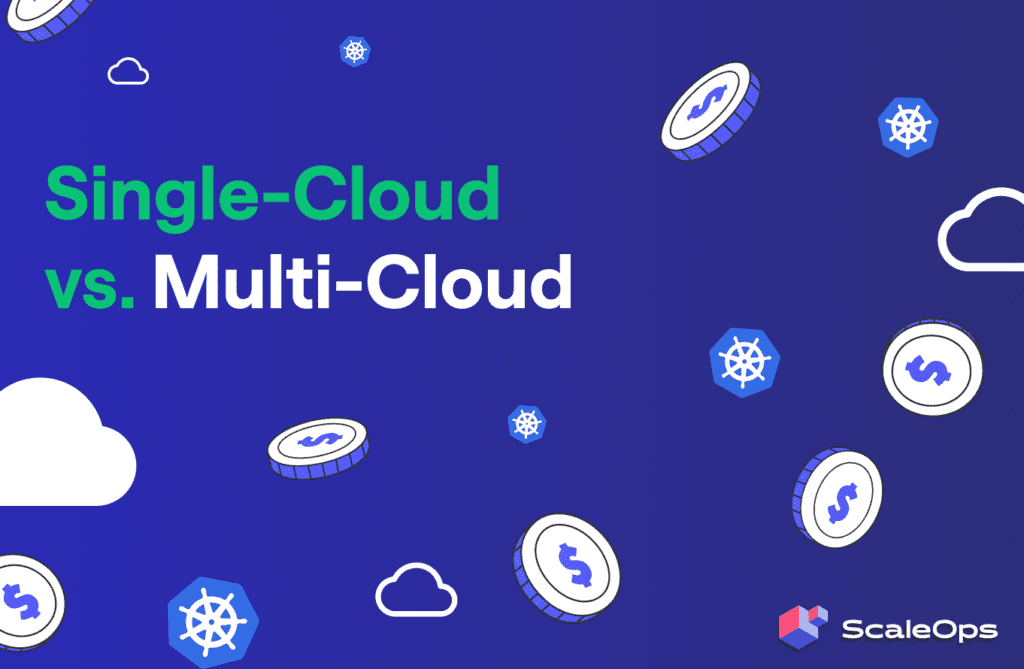
A robust automation system enables you to move past the single-cloud vs. multi-cloud debate and make informed choices based on clear outcomes: reliability, cost, and delivery speed.
Companies today need to run efficiently on a single provider and still have the option to extend across clouds with portable policies, consistent optimization, and a shared control plane.
With ScaleOps, autonomous resource management becomes the default, whether you run entirely on AWS or distribute workloads across multiple providers.
By combining multi-cloud resource management with Kubernetes resource automation, ScaleOps provides a consistent way to automate the management of both single-cloud and multi-cloud environments, while delivering measurable cost optimization across EKS, GKE, AKS, or any environments running Kubernetes.
Multi-cloud Kubernetes optimization is solvable when you stop treating each cloud as a separate optimization problem. The strategies above (consistent pod rightsizing, matched autoscaler behavior, unified Spot adoption, governance through one policy engine, a continuous optimization layer above native autoscalers) apply identically on EKS, GKE, and AKS. The platform that enforces them is what makes the difference between a multi-cloud strategy that delivers consistent cost outcomes and one that produces three different versions of the same problem.
Want to see the ScaleOps platform in action?
- Book a demo with a ScaleOps expert
- Start your 14-day free trial
Frequently Asked Questions
What is multi-cloud Kubernetes optimization?
Multi-cloud Kubernetes optimization is the practice of managing pod resources, node capacity, autoscaling, and governance consistently across Kubernetes clusters running on more than one cloud provider. It covers EKS, GKE, AKS, and on-prem clusters, with the goal of producing consistent cost and performance outcomes regardless of which cloud is underneath.
What are the main challenges of multi-cloud Kubernetes optimization?
The six recurring challenges are inconsistent autoscaling behavior across clouds, fragmented cost visibility, policy drift between clusters, duplicate tooling and operational overhead, inconsistent Spot capacity handling, and overprovisioning as the safe default response to complexity. Each challenge gets worse as the number of clouds in the fleet grows.
How do I optimize Kubernetes costs across GKE, EKS, and AKS?
The most consistent approach is to standardize pod requests on observed usage across all three clouds, run each cloud’s native autoscaler (Karpenter on EKS, GKE autoscaler, AKS Cluster Autoscaler), and place a single optimization layer above them that handles pod-level rightsizing, consolidation guardrails, and policy enforcement. This produces matching cost outcomes regardless of which cloud the cluster runs in.
How is multi-cloud Kubernetes optimization different from single-cloud?
The optimization tactics are the same: pod rightsizing, autoscaling, Spot adoption, reservations or committed-use discounts, and consolidation. The difference is operational. In single-cloud, one set of native tools and one operational playbook is enough. In multi-cloud, the same tactics need to be enforced consistently across multiple consoles, billing systems, and autoscaler implementations, which is where a unifying optimization layer becomes critical.
Can I use one tool to optimize Kubernetes across clouds?
Yes. Cloud-agnostic platforms such as ScaleOps provide a single optimization layer that applies consistent rightsizing, consolidation, and governance across EKS, GKE, AKS, on-prem, and hybrid clusters. The platform works with each cloud’s native autoscaler rather than replacing it, so existing infrastructure investments stay in place.
How do I reduce waste in multi-cloud Kubernetes?
Most multi-cloud waste comes from inconsistent pod requests across clusters. A pod sized correctly on EKS may be oversized on AKS if request standards differ between teams. The most effective single action is continuous, observed-usage-based pod rightsizing applied consistently across every cluster in the fleet. Node-level consolidation amplifies the savings once pod-level requests are accurate.
What are the best practices for multi-cloud Kubernetes efficiency?
The core best practices are: standardize pod requests on observed usage across clouds, configure each cloud’s autoscaler with matching consolidation and disruption budgets, treat Spot and equivalent capacity as a multi-cloud strategy not a per-cloud tactic, schedule non-production clusters consistently, commit to reservations only after rightsizing, unify observability and cost reporting, enforce governance through one policy engine, and run a continuous optimization layer above each cloud’s native autoscaler.
How do I control Kubernetes spend in multi-cloud environments?
Spend control requires three things working together: accurate pod-level inputs to each cloud’s autoscaler, unified visibility across cloud billing systems, and consistent policy enforcement that prevents drift. Without all three, optimization wins in one cloud get offset by waste in another. Cloud-agnostic platforms unify all three on top of existing autoscalers.
How do I standardize Kubernetes optimization across providers?
Standardization requires a control plane that operates independently of any cloud. This typically means GitOps-based cluster configuration, OPA or Kyverno for policy enforcement, and a single optimization platform that manages pod and node decisions consistently across providers. The native autoscalers (Karpenter, GKE autoscaler, AKS CA) stay cloud-specific, but the inputs they receive and the policies they enforce become uniform.